Blog
All our
The WIDID blog explores new ways of learning, teaching and engaging through immersive technologies.
Virtual reality, artificial intelligence, educational innovation, business applications, feedback and digital learning trends: here you’ll find our thoughts, analyses and advice to help you better understand the transformations taking place in training and learning.
A space designed to share our vision of immersive learning, as well as practical and useful content for businesses, trainers and innovation leaders.
Gamification and training
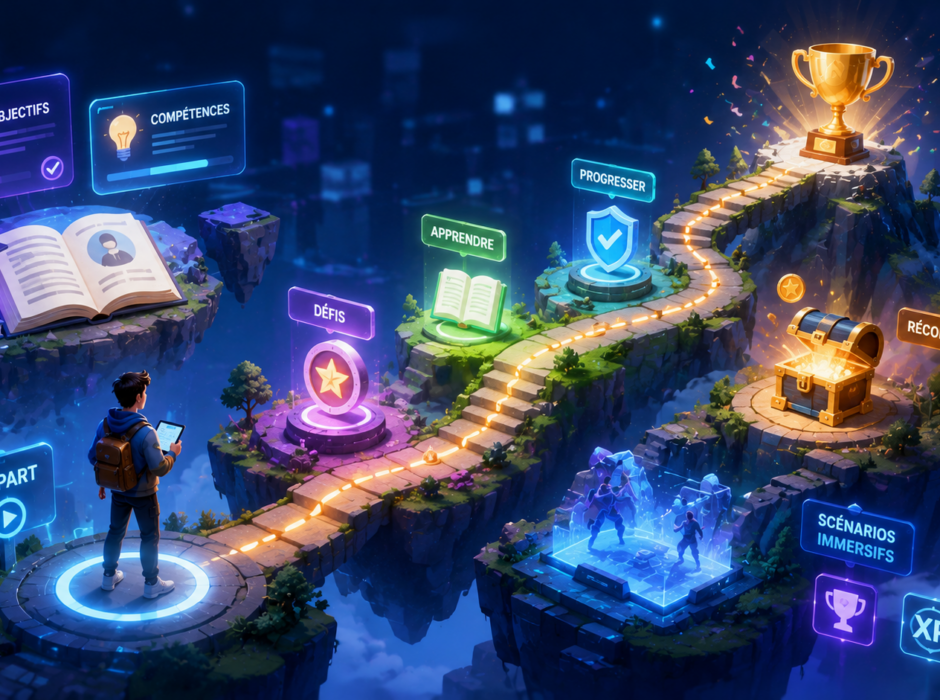
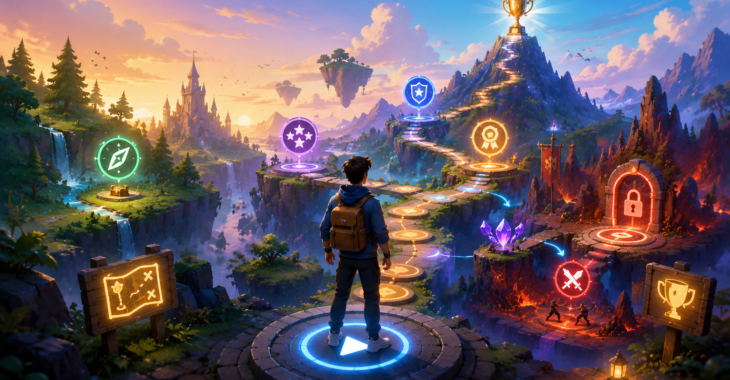
Gamification in training involves incorporating game-based mechanisms to boost learner engagement and facilitate the acquisition of new skills.
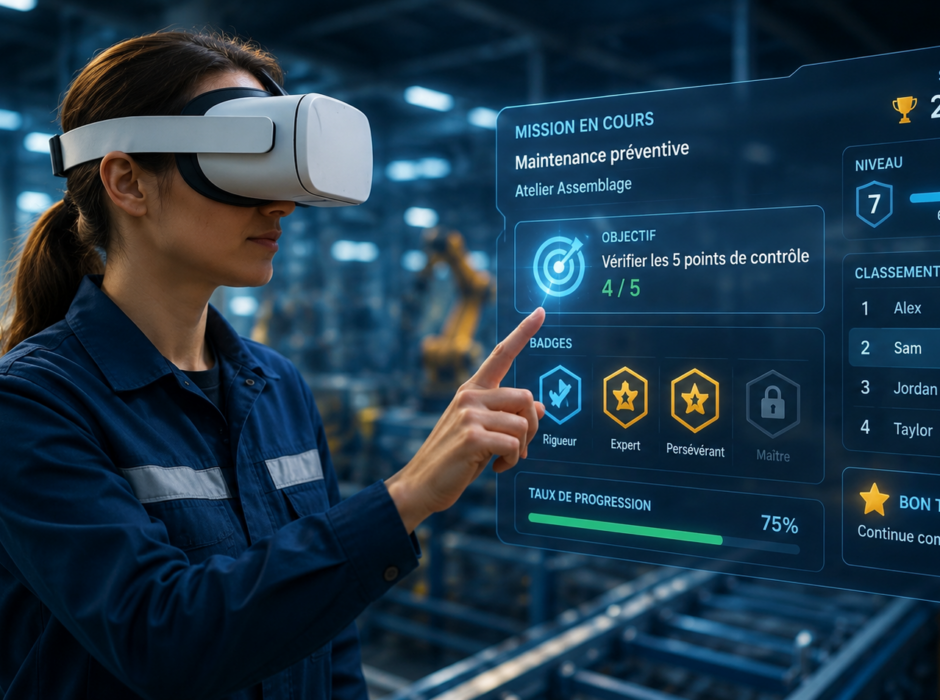
Challenges, levels, rewards, progression and immersive scenarios help transform what can sometimes be a passive learning experience into a more interactive and motivating process.
Combined with technologies such as virtual reality, gamification promotes engagement, retention and action by placing the learner at the heart of the experience.
Gamification: Bartle’s typology
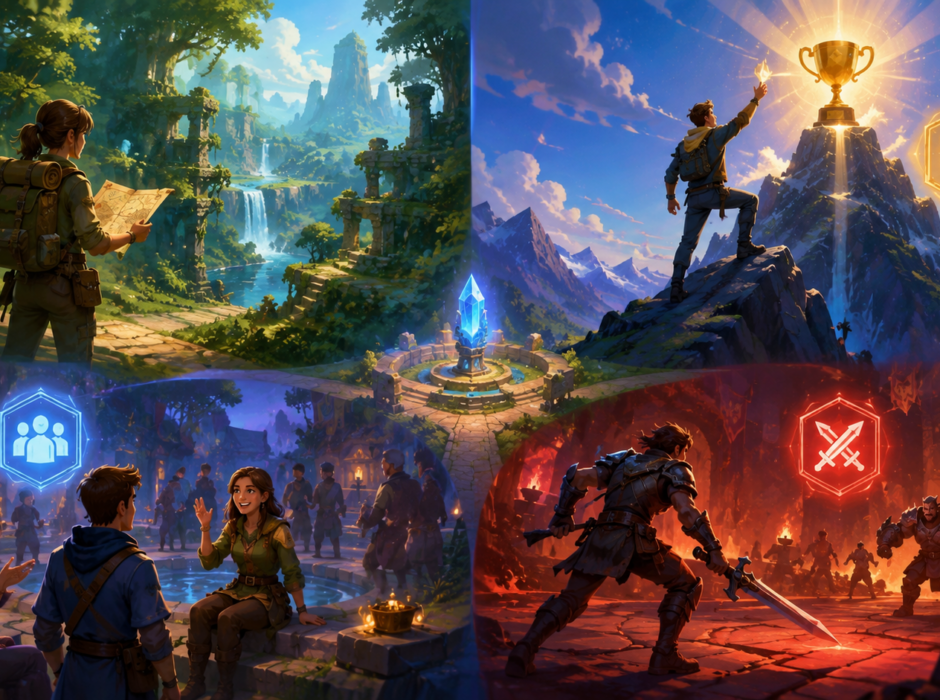
Bartle’s typology is a standard model used to understand different player profiles and their sources of motivation.
Developed by Richard Bartle, it identifies four main categories: Explorers, Achievers, Socialisers and Competitors .
Even today, this classification is widely used in the design of gamified experiences and immersive training programmes, as it enables game mechanics to be adapted to learners’ expectations and behaviours in order to boost their engagement.
What is gamification?
Gamification involves incorporating game mechanics into contexts that are not inherently playful.
Its aim is simple: to boost engagement, stimulate motivation and promote learning through elements such as challenges, rewards, levels and progression systems. When combined with immersive technologies such as virtual reality, it transforms the training experience into an interactive adventure where the learner takes full control of their own journey.
Does gamification have an impact on motivation?
Gamification is not simply about adding points, badges or leaderboards to a training course.
When well designed, it directly influences motivational mechanisms by strengthening engagement, a sense of progress and the desire to go further.
Combined with immersive experiences such as virtual reality, it transforms the learner into an active participant in their own learning journey and fosters lasting engagement.
Research shows, however, that its effectiveness depends above all on the quality of the educational scenario and its ability to stimulate intrinsic motivation rather than simply multiplying artificial rewards.
Why should we use microlearning?
In an age where our attention is increasingly in short supply, traditional training formats sometimes show their limitations.
Microlearning responds to this trend by offering short, targeted and easy-to-digest content.
An approach that promotes engagement, retention and learning when the need arises.
Bloom’s Taxonomy, training and Virtual Reality? Eureka!
From memorisation to creation, every learning process draws on different levels of skill.
Bloom’s taxonomy helps to structure this progression and is now a benchmark in the world of training.
Combined with virtual reality, it opens up new possibilities for learning more effectively through immersive and engaging scenarios.
WiDiD is Qualiopi-certified: recognition of our commitment to quality
At WiDiD, the quality of our training courses is more than just a promise – it is a commitment
We are proud to have renewed our Qualiopi certification, an official recognition that attests to the professionalism and rigour of our training processes.
But in practical terms, what does this mean for our clients and partners?
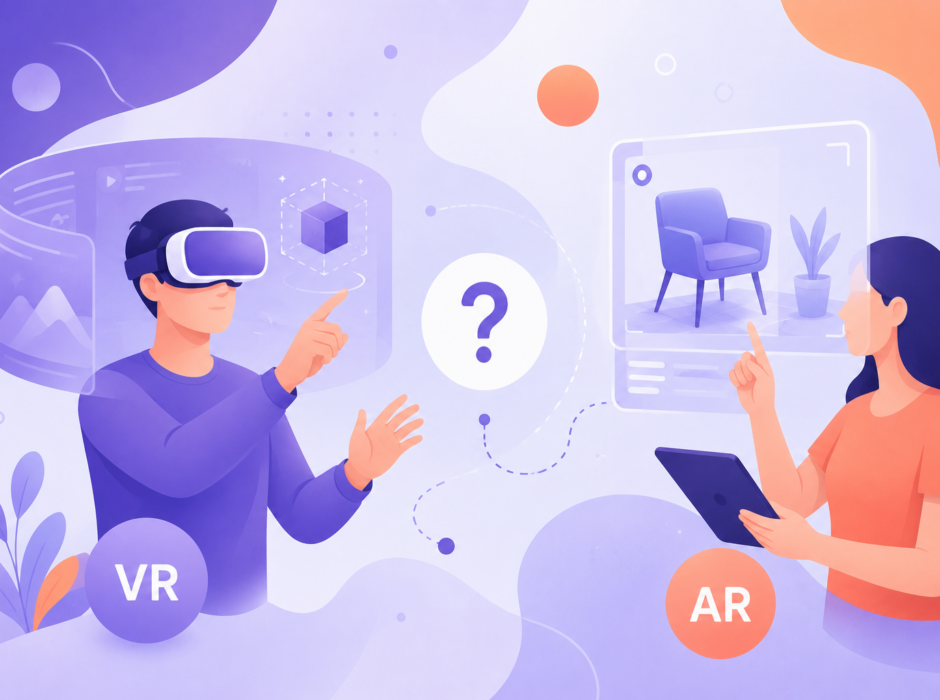
Understanding virtual and augmented reality to make the most of it
Until recently, virtual reality (VR) and augmented reality (AR) were used mainly by university research laboratories and the military.
In fact, they were the only ones who could afford them. The drastic fall in the cost of equipment means that everyone can now get their hands on them, and this is only the beginning!
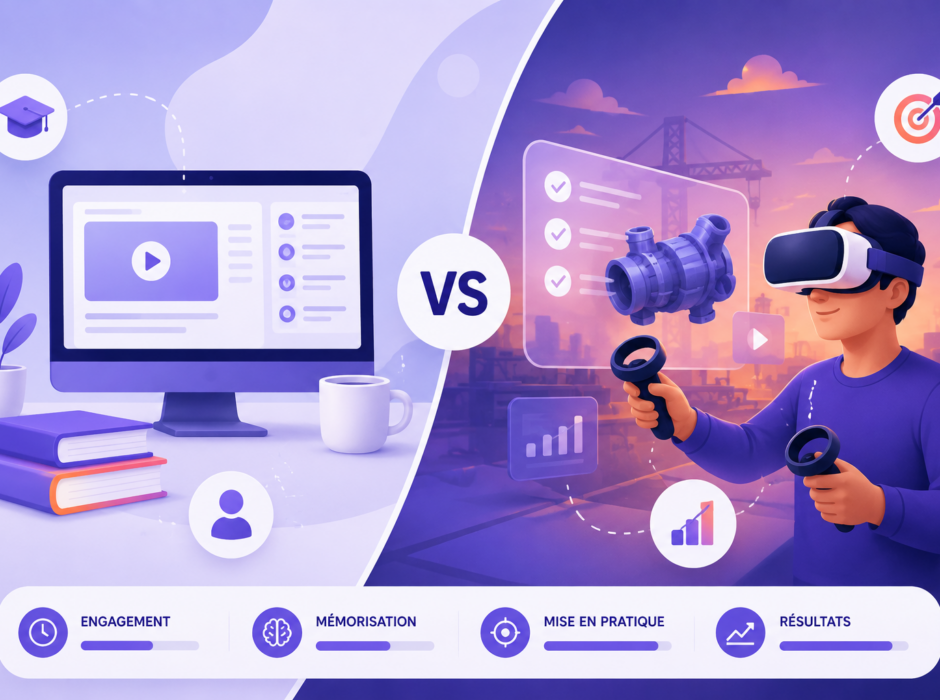
Virtual reality is more effective than e-learning
For several years now, e-learning has established itself as a flexible and accessible training solution.
But when it comes to developing skills, retaining information in the long term or recreating real-life situations, its limitations quickly become apparent.
Thanks to its level of immersion and interactivity, virtual reality offers a new way of learning that is more engaging and closer to real-world scenarios.
So, is VR really more effective than traditional e-learning? Results observed in practice tend to suggest so.