
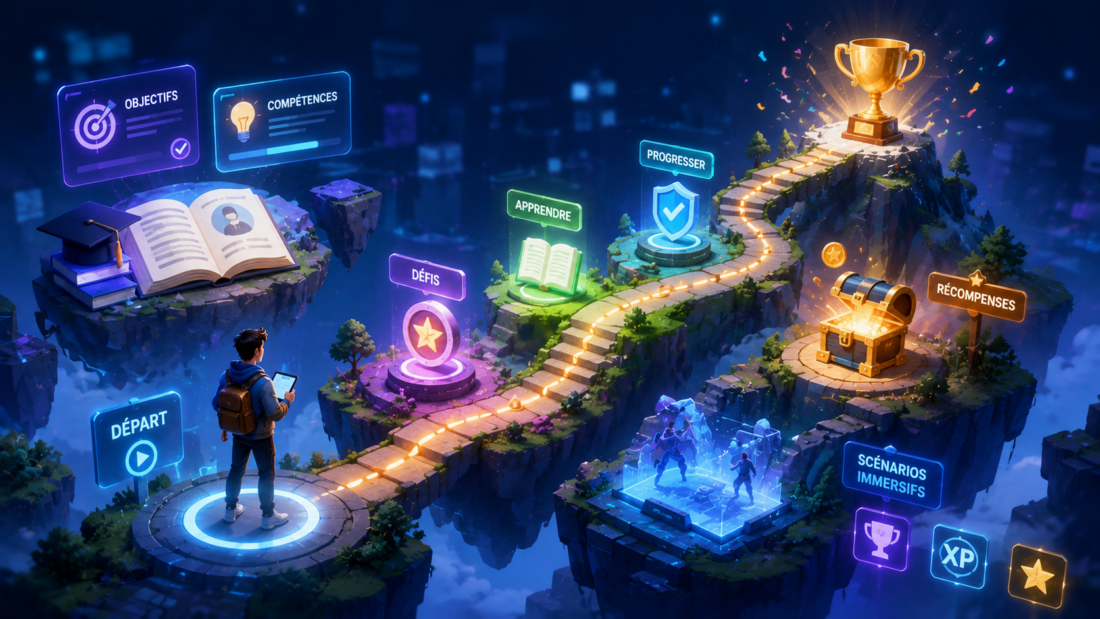
Gamification and training
Gamification in training involves incorporating game-based mechanisms to boost learner engagement and facilitate the acquisition of new skills.
Challenges, levels, rewards, progression and immersive scenarios help transform what can sometimes be a passive learning experience into a more interactive and motivating process.
Combined with technologies such as virtual reality, gamification promotes engagement, retention and action by placing the learner at the heart of the experience.
 Environ 3 min.
Gamification, sure, but in training?
In training, gamification should not be associated with the concept of a game, but rather with that of a learning profile. What we have just seen with Bartles’ typology is a very good starting point.
The aim is to transform the traditional learning experience—such as e-learning and videos—into fun and engaging training content for all types of learners and players.
One of the simplest forms of gamification, which we’re all familiar with, involves collecting a stamp every time you buy a product, such as a burger. Collect ten stamps and get a free drink. It’s like completing a level and getting a reward!

In a training module, this might involve using elements such as leaderboards, progress bars, points and so on. These techniques tap into our natural instincts: competition, exploration, curiosity and sharing.
Who uses it?
Gamification is used in many learning platforms, such as:
- Codeacademy, which offers progress bars, badges and points.
- Duolingo does the same thing, but for language learning, with the option to set goals.
- Watura Academy is a learning platform for careers in the water sector; it uses badges, points and leaderboards to motivate learners, as well as a progress chart for their chosen career.
- TalentLMS is a learning platform that uses gamification to deliver content.
Nowadays, many companies want to incorporate gamification into their training content using an LMS platform. But before getting started, it’s essential to understand how to set it up and use it. It is by using game mechanics wisely that your training courses will become the Candy Crush of learning! WiDiD supports you in implementing gamification within your company.
What makes gamification so powerful is that it taps into emotions associated with a positive experience. Indeed, the learner feels in control of their own learning and progress; they do not feel pressured to make progress. They always have an overview of their learning and can visualise their goal through badges, points and so on. They must not fail; the experience must always be positive. Success is one of the most powerful psychological factors in human behaviour. Everything we do, we do to achieve something.
To read on, click here.
Plus d'articles
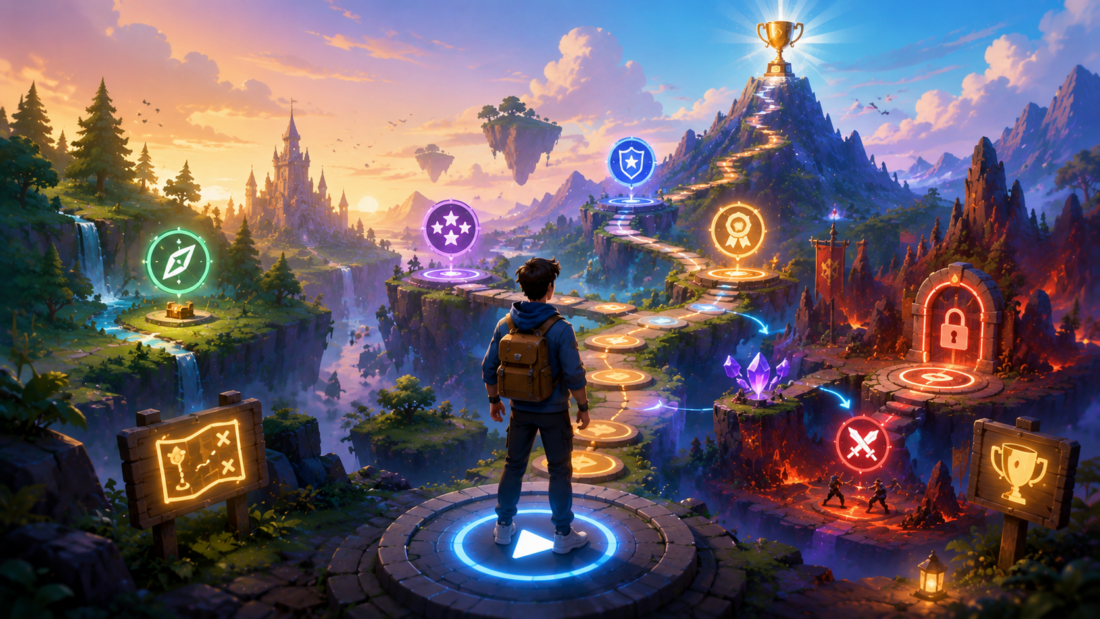
Gamification: it’s your turn!
Gamification is not just about making training more fun: its primary aim is to foster long-term engagement among learners by placing them at the heart of the experience.
By utilising mechanisms such as challenges, progression, rewards and exploration, it fosters engagement, perseverance and a desire to learn. When integrated into a coherent educational approach, gamification becomes a powerful tool for transforming learning into an active and stimulating experience.

Bloom’s Taxonomy, training and Virtual Reality? Eureka!
From memorisation to creation, every learning process draws on different levels of skill.
Bloom’s taxonomy helps to structure this progression and is now a benchmark in the world of training.
Combined with virtual reality, it opens up new possibilities for learning more effectively through immersive and engaging scenarios.

Gamification: Bartle’s typology
Bartle’s typology is a standard model used to understand different player profiles and their sources of motivation.
Developed by Richard Bartle, it identifies four main categories: Explorers, Achievers, Socialisers and Competitors .
Even today, this classification is widely used in the design of gamified experiences and immersive training programmes, as it enables game mechanics to be adapted to learners’ expectations and behaviours in order to boost their engagement.