
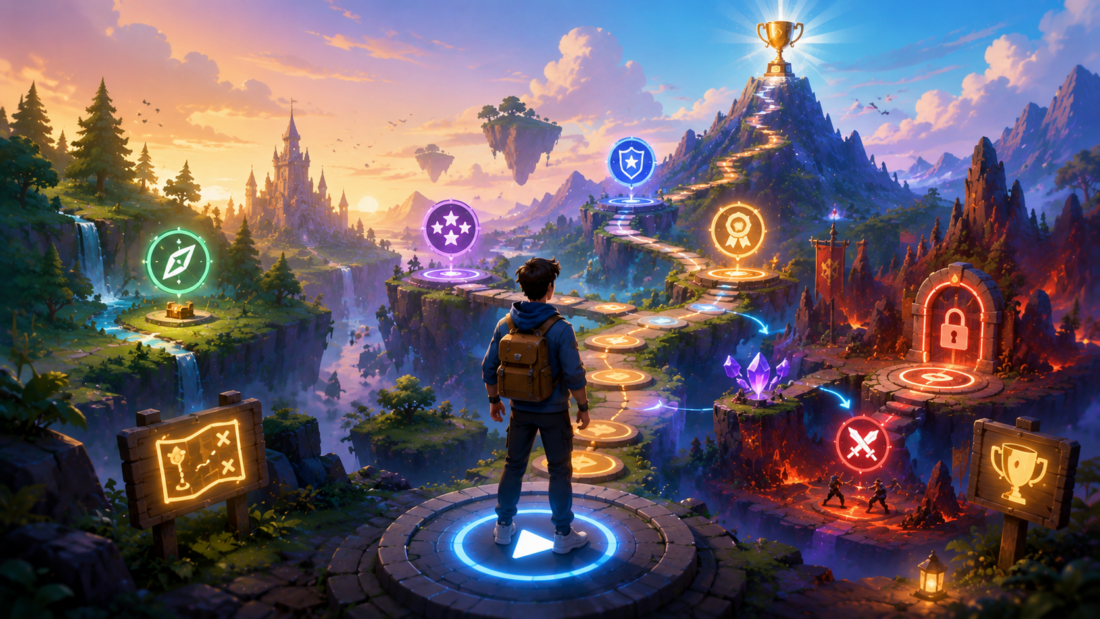
Gamification: it’s your turn!
Gamification is not just about making training more fun: its primary aim is to foster long-term engagement among learners by placing them at the heart of the experience.
By utilising mechanisms such as challenges, progression, rewards and exploration, it fosters engagement, perseverance and a desire to learn. When integrated into a coherent educational approach, gamification becomes a powerful tool for transforming learning into an active and stimulating experience.
 Environ 5 min.
Now it’s your turn!
If someone signs up for your course, they’re trying to achieve something. For example, they might want to learn about cybersecurity, find out more about it, or make progress in this field.
If you make your learner feel that they’ve achieved something, they’ll come back. Something as simple as saying “Great work!” when a learner completes a task – whether complex or not – helps to create a milestone and gives the impression of having completed a level.
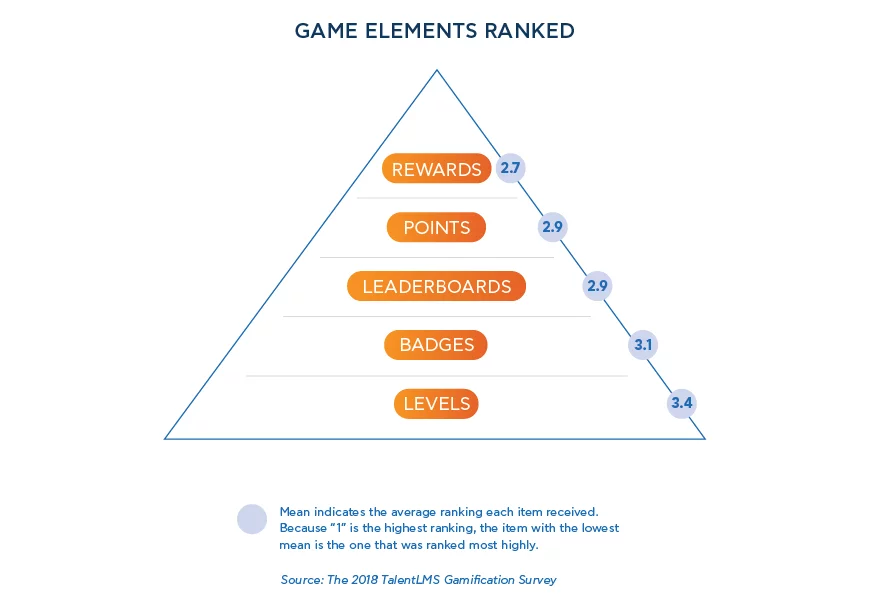
Offering rewards such as badges at the end of a module helps to reinforce a habit or behaviour. Depending on your learner’s profile, this will engage them even more.
For example, an achiever/collector who learns step by step will aim to collect as many badges as possible; they’ll want to complete everything.
Don’t forget, we’re competitive by nature. Most of us want to go further and be the best. By using ‘personal bests’ or leaderboards, you can encourage your learners to come back and try to do better than last time.
Show them their statistics and they’ll almost always want to improve them.
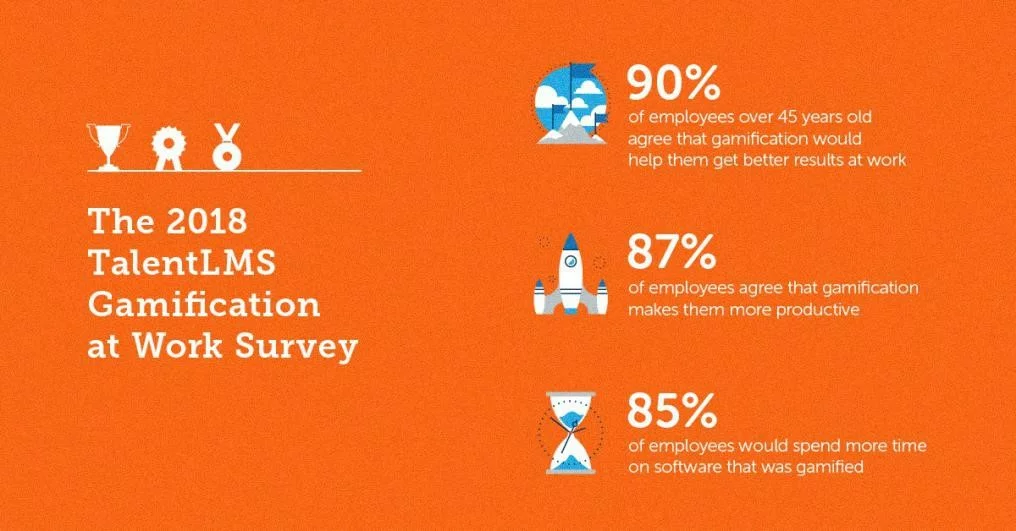
And above all, don’t forget that it’s not just for young learners – gamification is universal. A study by TalentLMS carried out in the United States shows that 90% of employees over the age of 45 agree that gamification helps them achieve better results at work.
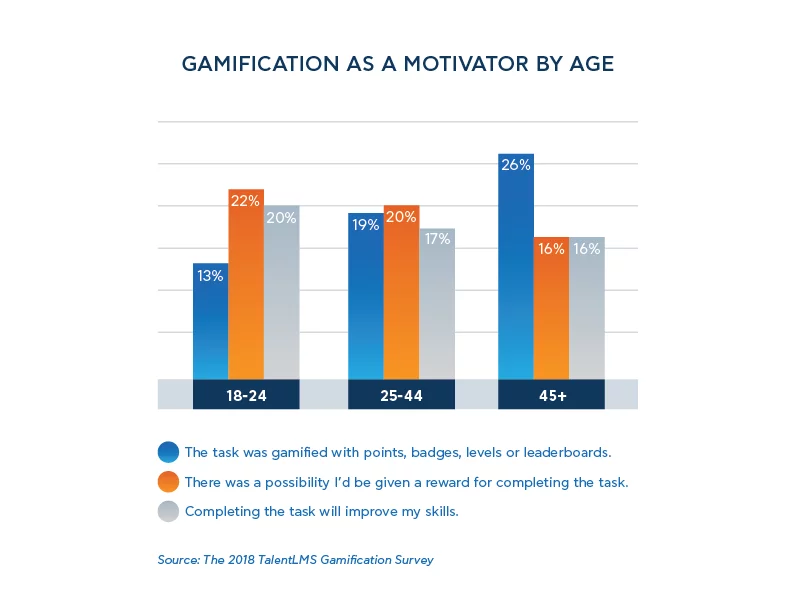
But be careful – you shouldn’t just apply gamification indiscriminately. You need to take an interest in your learners and what motivates them. You need to be able to answer the following question:
What motivates my learners, and how, to ensure that gamification is meaningful?
And what about virtual reality?
Now that you know all about gamification, it would be a shame not to take it a step further. With virtual reality serving as WiDiD’s playground, it would be absurd not to make the connection with gamification. E-learning becomes like a game in which the learner is immersed in a realistic scenario. The advantage is that they can interact with their environment, make progress, visualise their actions and perform the movements.
The use of gaming mechanics and virtual reality in a training programme makes the content more engaging and influences learners’ performance, even before they enter the real-world environment. Indeed, they will have retained their actions better by practising them.
For further reading, listen to Nicolas Lozancic’s podcast.
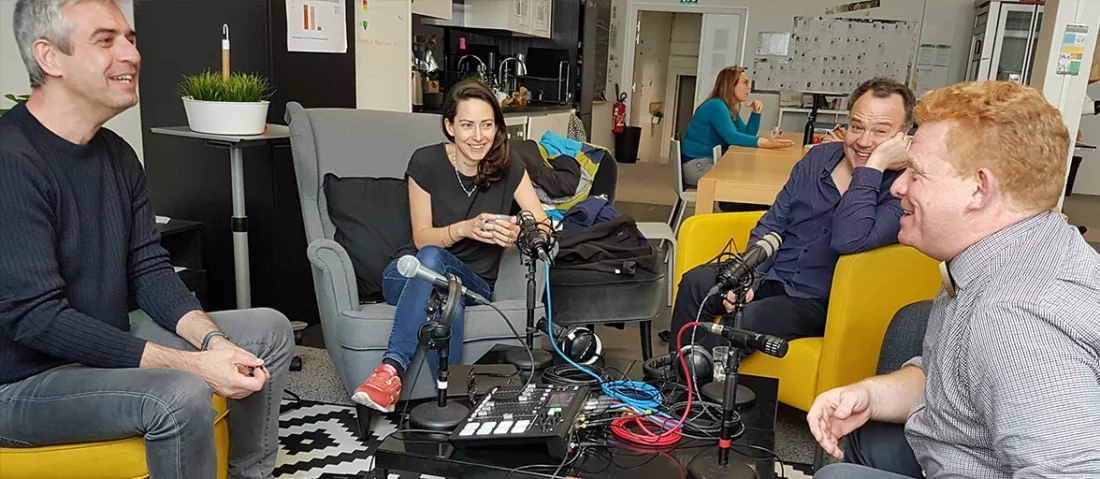
Recording of the podcast “Play, I say!”
Bonus
If you’ve made it to the end of the article, well done!
Now you know a bit more about gamification. To round off the background, here’s a brief explanation of the D&D video game.
D&D is a role-playing video game released in 1974. The name D&D is derived from the abbreviation ‘D&D’ of the original tabletop role-playing game Dungeons & Dragons.
D&D was the first interactive game to use what would later be known as ‘bosses’ (enemies, usually more powerful than the others, to be defeated at the end of a level), a feature found in almost all games today.
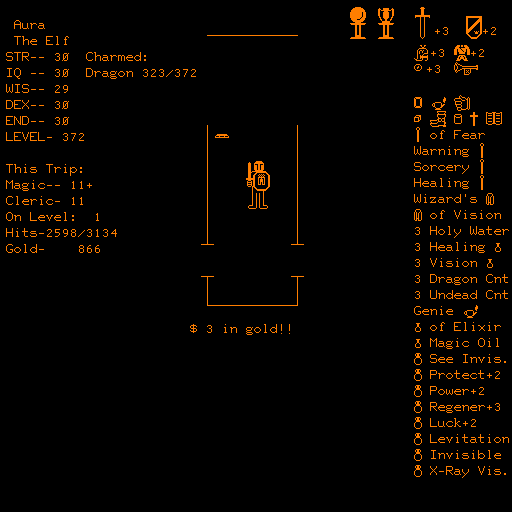
In terms of gameplay, players create a character and venture into the multi-level Whisenwood Dungeon in search of two ultimate treasures: the Grail and the Orb.
The Whisenwood Dungeon consists of several maze-like levels; players who complete each level are allowed to proceed to the next, but can return to previous levels and leave the dungeon entirely. It is, in fact, one of the first video games to use a non-linear mode.
- As players complete levels, they acquire new spells, weapons and items to help them in their quest for the ultimate treasure.
- Teleporters move characters between dungeon levels. High-level monsters, including a golden dragon guarding the Orb, can be found at the end of each dungeon.
- Leaving the dungeon allows you to rest, recharge your spells and return later.
We’ve clearly been inspired by this game to build loyalty and attract our learners 😉
Plus d'articles

Bloom’s Taxonomy, training and Virtual Reality? Eureka!
From memorisation to creation, every learning process draws on different levels of skill.
Bloom’s taxonomy helps to structure this progression and is now a benchmark in the world of training.
Combined with virtual reality, it opens up new possibilities for learning more effectively through immersive and engaging scenarios.
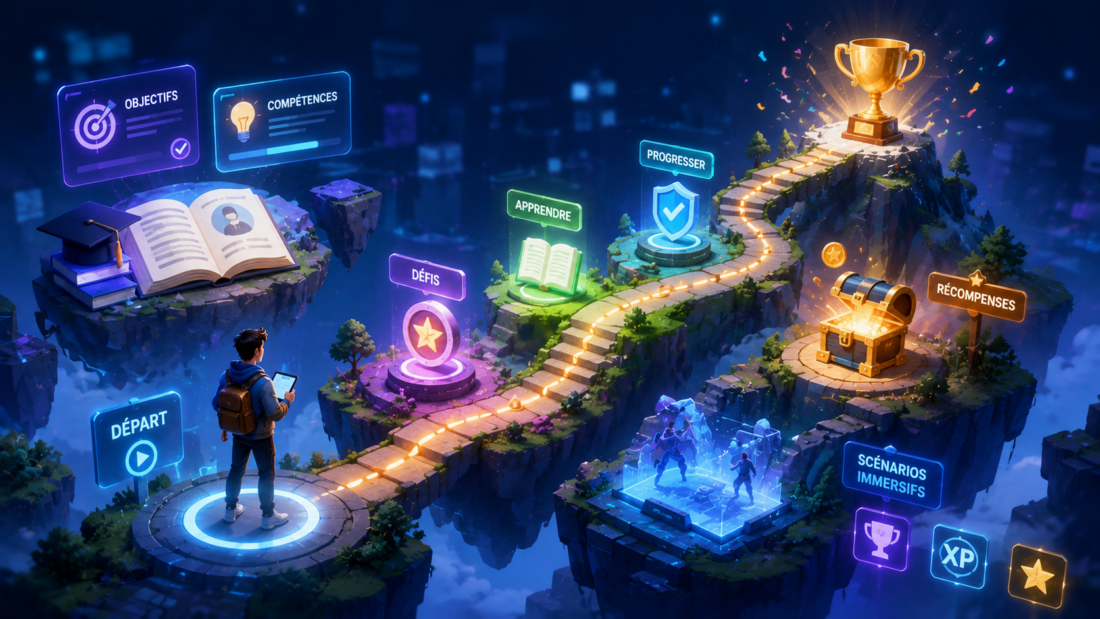
Gamification and training
Gamification in training involves incorporating game-based mechanisms to boost learner engagement and facilitate the acquisition of new skills.
Challenges, levels, rewards, progression and immersive scenarios help transform what can sometimes be a passive learning experience into a more interactive and motivating process.
Combined with technologies such as virtual reality, gamification promotes engagement, retention and action by placing the learner at the heart of the experience.
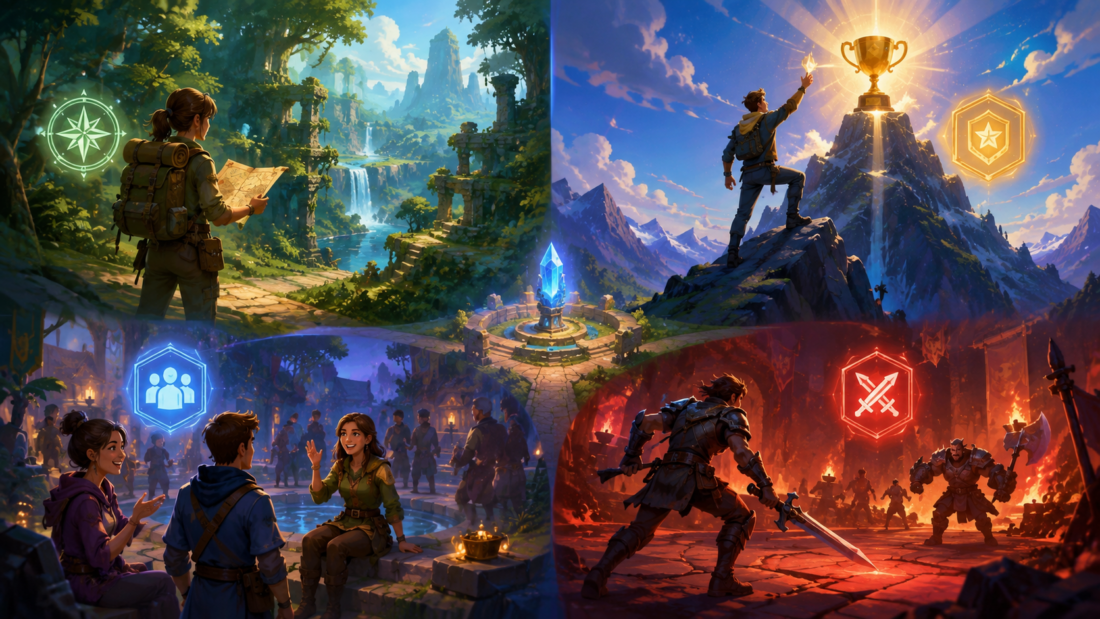
Gamification: Bartle’s typology
Bartle’s typology is a standard model used to understand different player profiles and their sources of motivation.
Developed by Richard Bartle, it identifies four main categories: Explorers, Achievers, Socialisers and Competitors .
Even today, this classification is widely used in the design of gamified experiences and immersive training programmes, as it enables game mechanics to be adapted to learners’ expectations and behaviours in order to boost their engagement.