
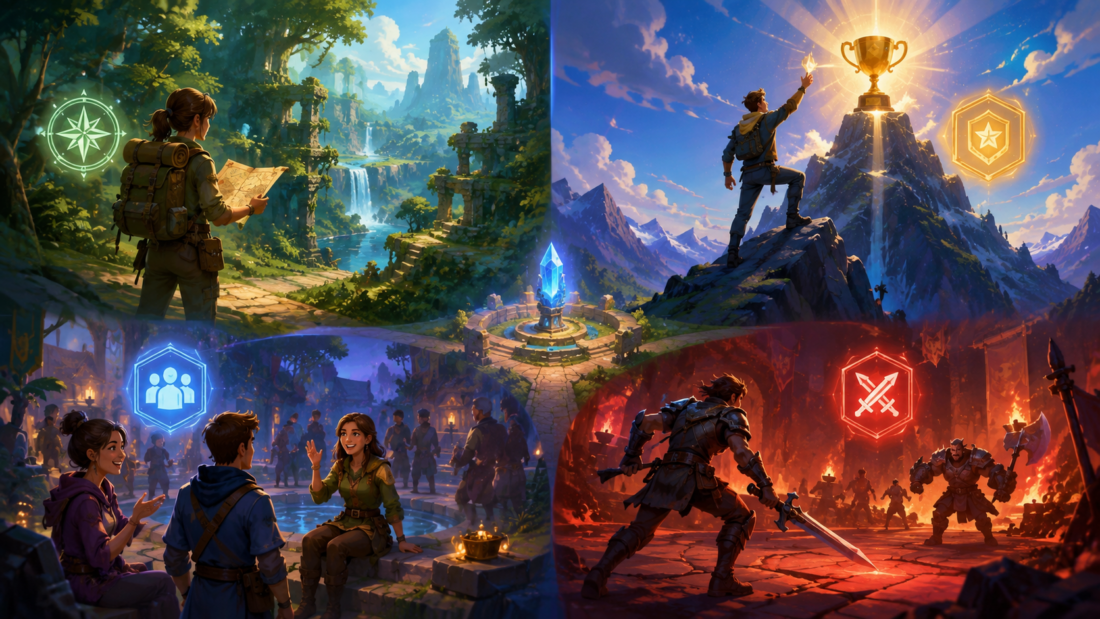
Gamification: Bartle’s typology
Bartle’s typology is a standard model used to understand different player profiles and their sources of motivation.
Developed by Richard Bartle, it identifies four main categories: Explorers, Achievers, Socialisers and Competitors .
Even today, this classification is widely used in the design of gamified experiences and immersive training programmes, as it enables game mechanics to be adapted to learners’ expectations and behaviours in order to boost their engagement.
 Environ 4 min.
Bartles’ typology
As Anna-Livia explains in her MOOC, it is essential to know your target audience.
Let’s take a concrete example: when we play a game, there is a story, a set of rules and players, but what drives us to keep playing is individual. It will depend on our motivational drivers and therefore on our personality type.
Richard Bartles has developed a typology of players, which is extremely important for anyone wishing to gamify their content. In the context of training, Bartles’ typology helps you understand what will engage and motivate your learners.
Below is an illustration to help you understand what a learner likes, how they learn, the mechanics you should use, and what drives them.
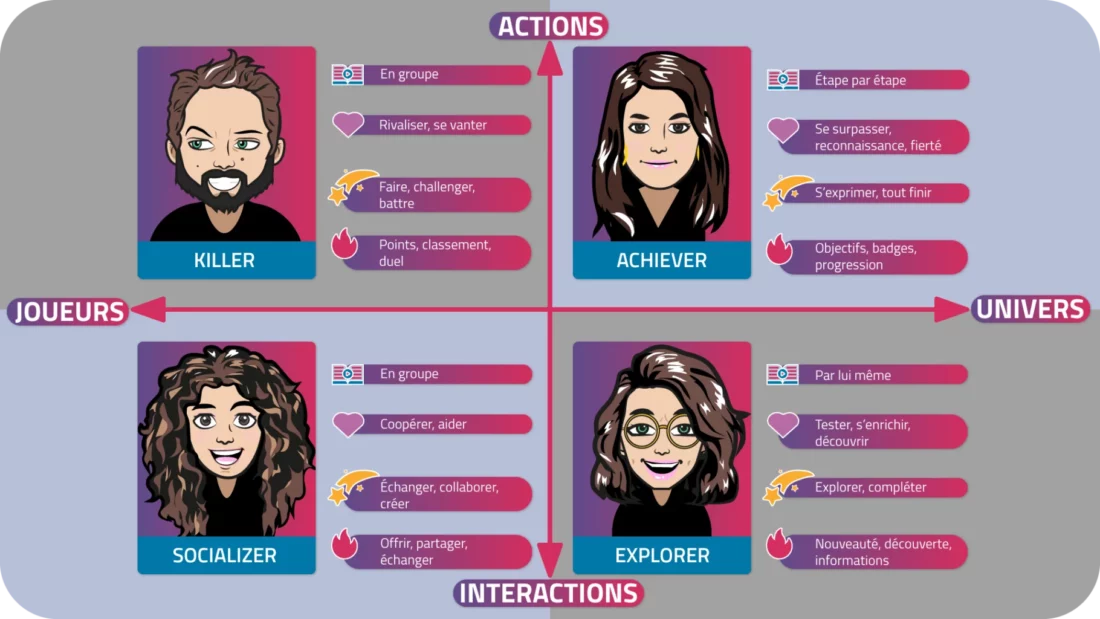
These four types – Achiever, Explorer, Socialiser and Killer – coexist within an individual, but one type predominates in each person.
A breakdown of the four profiles
- Achievers and collectors want to make a difference in the world. Their aim is to master it. They move forward step by step, guided by the concepts of goals and progress. They will proudly display their achievements, for example through badges. They will feel a real sense of pride at having completed everything.
- Explorers want to engage with the world. Their aim is to dissect what the world has to offer, to uncover its flaws or points of interest. They take pride in explaining their knowledge to others, without, of course, revealing everything to them. They need to do things for themselves, without help, and to learn new things every time.
- Socialisers want to interact with other players. Their aim is to be part of a group, to share and to chat. If there’s no opportunity to interact, they’ll get bored.
- Killers want to make an impact on other players. Their aim is to demonstrate their superiority over others, so they prefer to play in groups, just like socialisers, but with the aim of competing against one another. They want to top the leaderboard, engage in duels and beat the others.
Now that you know all about Bartle’s typology, I invite you to take this quick test (in English) to find out your dominant profile. Your profile will be broken down across each of the profiles, totalling 200%.
Having taken the test, I’m 80% Explorer (dominant profile); however, I’m also keen to see it through to the end, and I can confirm that’s exactly what I’ve done! Here are the details and my self-analysis:
- 80% Exploration –> When I’m playing or learning, the first thing that interests me is the storyline and what I can discover. Next, I’ll complete the main quest, and if I haven’t got bored, I’ll do the rest. But my main goal isn’t to see it through to the end; I like to wander around, explore, and discover what I can do.
- 47% Achiever –> I quite like badges and seeing the boxes ticked off 🙂
- 40% Socialising –> a bit of interaction too, but mainly to discover environments other than my own
- 33% Killer –> we’re all a bit like that; personally, I like to be the best at what I love, but when it comes to everything else, I’m happy to be bottom of the pile!
To read on, click here.
Plus d'articles
Gamification: it’s your turn!
Gamification is not just about making training more fun: its primary aim is to foster long-term engagement among learners by placing them at the heart of the experience.
By utilising mechanisms such as challenges, progression, rewards and exploration, it fosters engagement, perseverance and a desire to learn. When integrated into a coherent educational approach, gamification becomes a powerful tool for transforming learning into an active and stimulating experience.

Bloom’s Taxonomy, training and Virtual Reality? Eureka!
From memorisation to creation, every learning process draws on different levels of skill.
Bloom’s taxonomy helps to structure this progression and is now a benchmark in the world of training.
Combined with virtual reality, it opens up new possibilities for learning more effectively through immersive and engaging scenarios.
Gamification and training
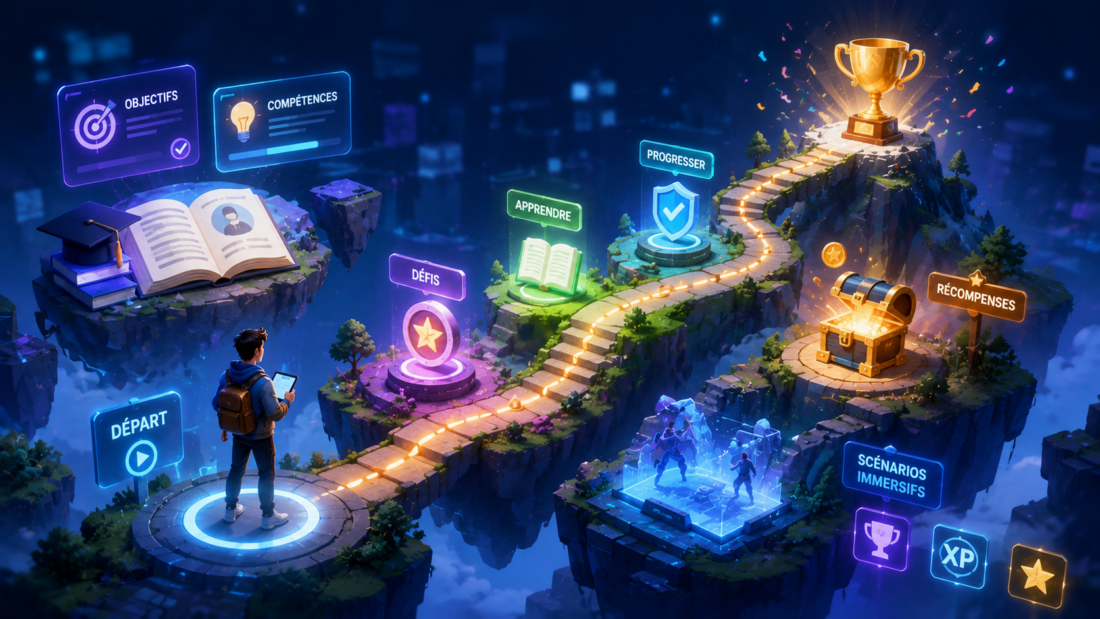
Gamification in training involves incorporating game-based mechanisms to boost learner engagement and facilitate the acquisition of new skills.
Challenges, levels, rewards, progression and immersive scenarios help transform what can sometimes be a passive learning experience into a more interactive and motivating process.
Combined with technologies such as virtual reality, gamification promotes engagement, retention and action by placing the learner at the heart of the experience.