
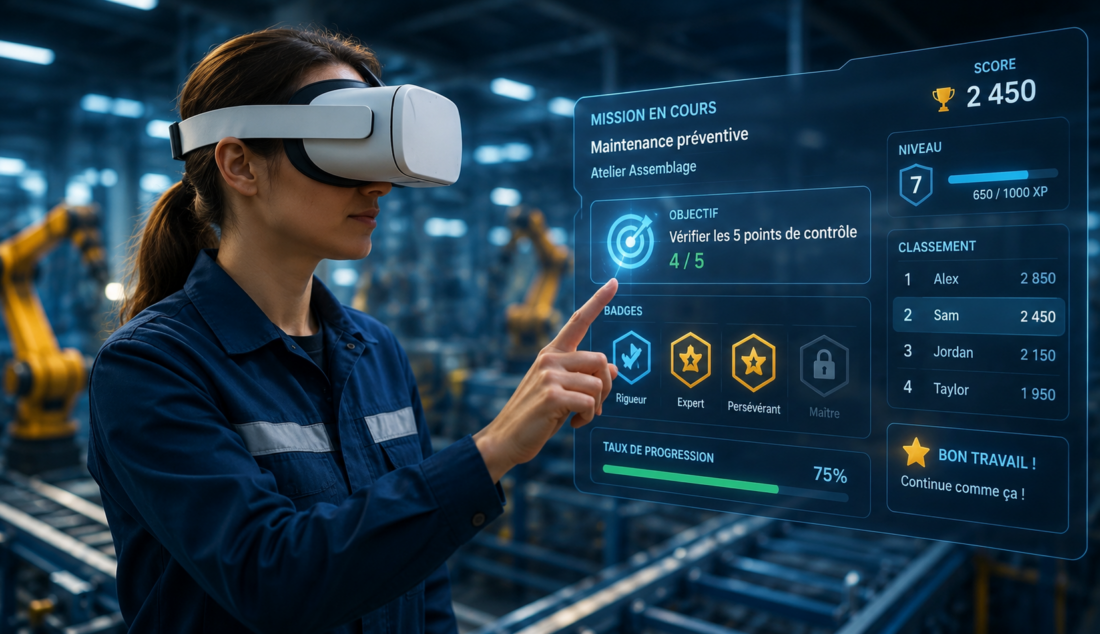
Does gamification have an impact on motivation?
Gamification is not simply about adding points, badges or leaderboards to a training course.
When well designed, it directly influences motivational mechanisms by strengthening engagement, a sense of progress and the desire to go further.
Combined with immersive experiences such as virtual reality, it transforms the learner into an active participant in their own learning journey and fosters lasting engagement.
Research shows, however, that its effectiveness depends above all on the quality of the educational scenario and its ability to stimulate intrinsic motivation rather than simply multiplying artificial rewards.
 Environ 11 min.
Definition of motivation
There are several definitions of motivation in the literature, which differ slightly from one another, mostly due to differences in explanatory models. However, there is a consensus on the main aspects of motivation. Here is the definition on which everyone agrees:
“Motivation is the set of variables and processes that determine the initiation, direction and maintenance of behaviour.”
You’re certainly no closer to a solution. This is the problem with definitions, and it’s all the more true in the scientific field. Let’s break down the statement together. ‘Processes’ are either emotional, social or cognitive. They may therefore refer to a sense of joy felt whilst performing the behaviour, or to a social influence. ‘Variables’ refer to anything that isn’t a process and that may influence motivation. Finally, the last three terms characterise the essential aspects of motivation. To achieve a goal, such as reading this article to the end, the desire to finish the page is not enough. You must be able to initiate the decision (i.e. to finish reading) and sustain it with a certain intensity. Thus, if the decision is not sustained sufficiently, you are likely to move on to something else. Therefore, desire alone is not enough.
The two types of motivation
Researchers distinguish between two types of motivation: extrinsic motivation, which relates to everything external to the individual, and intrinsic motivation, which is internal to the individual. The diagram below summarises the two types of motivation well. What is missing from this image is that the elements of intrinsic motivation (i.e. curiosity, interest, etc.) must always be considered in relation to the task being performed, for example a geography lesson.
Let’s take an example to illustrate this difference. Bobby, an employee at an engineering firm, has to complete a public speaking course on the WiDiD catalogue to improve his presentation skills for an upcoming seminar. What will drive Bobby to complete the entire course is certainly not his interest in the course itself. Although VR does tend to make quite an impression. Rather, it is because his company expects him to do so, because it is part of his duties as an employee, and so on. These reasons fall under extrinsic motivation as they are not linked to the task itself nor to characteristics inherent to the individual. Bobby isn’t doing the training because he enjoys it. However, it is possible that by doing the training, he may develop an interest in public speaking. In that case, his motivation will no longer be entirely extrinsic but also intrinsic. Bobby will complete the training because he enjoys it, and because it is part of his duties. This illustrates the non-binary nature of motivation. If intrinsic motivation is present, it does not mean that extrinsic motivation is necessarily absent.
Much like protons, which contain other elements, some researchers have broken extrinsic motivation down into three parts, whilst others, drawing on self-determination theory, identify four. As for intrinsic motivation, it is less frequently divided, and there is less consensus on how it should be categorised. Vallerand and his team identify three components within intrinsic motivation:
- Intrinsic motivation to learn = The pleasure of learning something.
- Intrinsic motivation to achieve = The pleasure of accomplishing something.
- Intrinsic motivation for stimulation = Sensory pleasure, aesthetic pleasure, emotions.
I have outlined these different types because they will help you better understand the topic we are about to explore.
Motivation and Gamification
Now that we’ve got a bit of an understanding of the concept of motivation from a psychological perspective, it’s time to get to the heart of the matter. Before we go any further, I recommend that you read the articles defining and exploring the concept of gamification (here). You can also listen to this podcast, which explains the concept clearly.
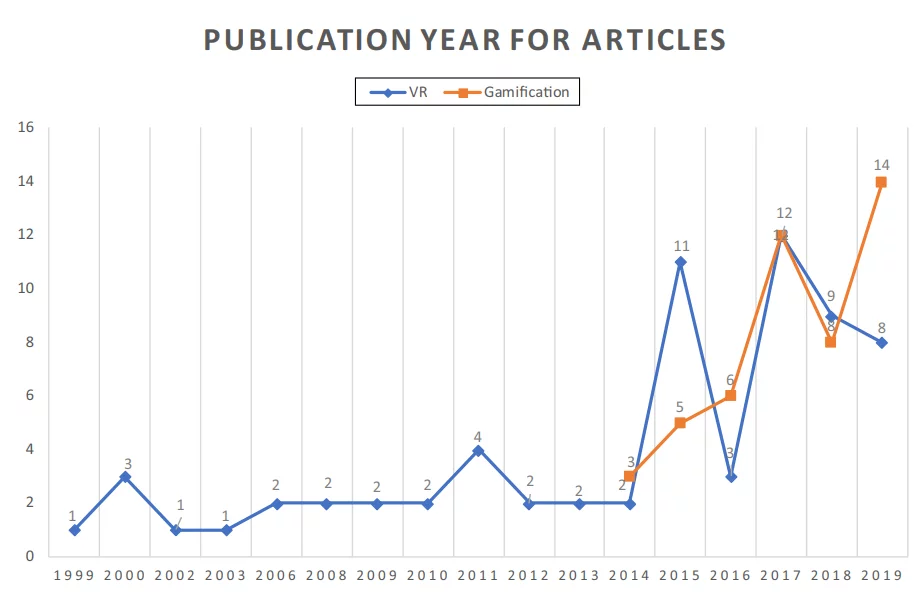
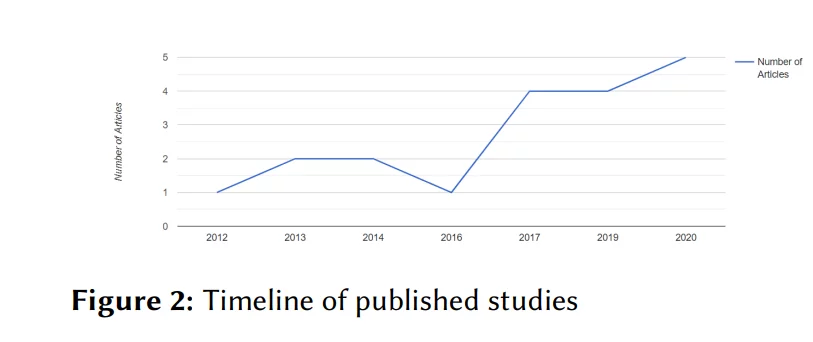
Gamification is now a rapidly expanding field of research, as illustrated in Figures 1 and 2. This innovative field saw its first articles on the subject published in 2014, and it holds great promise for many sectors (e.g. education, marketing, etc.). In this blog post, we will focus on the field of education.
As a relatively new concept, gamification has not yet made its way into schools or universities. However, a growing number of studies are providing evidence of its potential to motivate and empower learners in the learning process. It is important to bear in mind, however, that gamification in itself is not a game. Gamification does not make just anything fun. Don’t believe it? Try this parody of gamification, Progress Wars, for yourself.

It is therefore essential to be thorough when designing a gamified system. The study we are about to examine briefly highlights another limitation to bear in mind: gamification does not work in the same way for everyone.
The aim of the study by Buckley and his team is to advance the debate on the use of gamification in schools. To this end, they recruited around 100 students taking part in a gamified learning programme on the national tax system (Ireland). Three measures were assessed: their extrinsic and intrinsic motivation, and their performance regarding the national tax system.
The gamified system utilised a “prediction market”. The tool involves placing bets on an uncertain future outcome, such as the completion of an assignment. If the task is completed on time, its value increases; otherwise, it decreases. Each student can thus see their value and earnings, which are displayed in real time using a virtual currency. In the study, predictions were made on questions relating to the national tax system, such that the more knowledge a student had of the system, the better their predictions were.
The tool thus made it possible to bring together all the gamification elements identified in the literature as being the most relevant:
- Objective, specific rules: Gamified activities have clear rules that determine what the player can and cannot do.
- Rewards: SAPS reward system (Status = Social status, Access = Access to exclusive items, Power = Power, and Stuff = Items to be won).
- A quick review of the learner’s performance.
- Competitive elements, rankings, scores, etc.
The results show that the gamified system improves knowledge of the national tax system. However, the absence of a control group means it cannot be concluded that it is more effective. With regard to intrinsic motivation, only intrinsic motivation for achievement was not positively correlated with the system. In other words, intrinsic motivation towards achievement did not significantly predict the effectiveness of the gamified system. For extrinsic motivation, the opposite was true, as only extrinsic motivation for identification reached the threshold of significance. The authors explain this lack of results by the nature of the gamified system, which was radically different from the traditional system found in the education system. They also note that some students were unable to make use of the system to improve their learning. On the contrary, they experienced greater difficulties.
What we saw
We have seen what motivation is, the two main components that make it up, and how gamification has become a trendy area of scientific research. We have also listed the gamification elements used in the study and recognised in the literature. Finally, motivation is indeed influenced by gamification, but on closer inspection, this relates to ‘intrinsic motivation to learn’, ‘stimulation-based motivation’, and ‘extrinsic identification motivation’. Thus, the relationship between motivation and gamification is not so straightforward, and these points must be borne in mind when implementing a gamified system.
References
Motivation
Camus, Gauthier, Sophie Berjot, Camille Amoura, and Jacques Forest. “A Scale for (Re)working Motivation: Towards a New Approach to Self-Determination Theory. ” Canadian Journal of Behavioural Science / Revue canadienne des sciences du comportement 49, no. 2 (2017): 122–32. https://doi.org/10.1037/cbs0000072.
The study discussed in this post
Buckley, Patrick, and Elaine Doyle. ‘Gamification and student motivation’. Interactive Learning Environments 24, no. 6 (17 August 2016): 1162–75. https://doi.org/10.1080/10494820.2014.964263.
Other studies on gamification from which the graphs are taken
Loureiro, Sandra Maria Correia, Ricardo Godinho Bilro, and Fernando José de Aires Angelino. “Virtual Reality and Gamification in Marketing Higher Education: A Review and Research Agenda”. Spanish Journal of Marketing – ESIC 25, no. 2 (8 October 2021): 179–216. https://doi.org/10.1108/SJME-01-2020-0013.
Oliveira, Wilk, Olena Pastushenko, Luiz Rodrigues, Armando M. Toda, Paula T. Palomino, Juho Hamari, and Seiji Isotani. “Does Gamification Affect Flow Experience? A Systematic Literature Review”. ArXiv:2106.09942 [Cs], 18 June 2021. http://arxiv.org/abs/2106.09942.
Plus d'articles
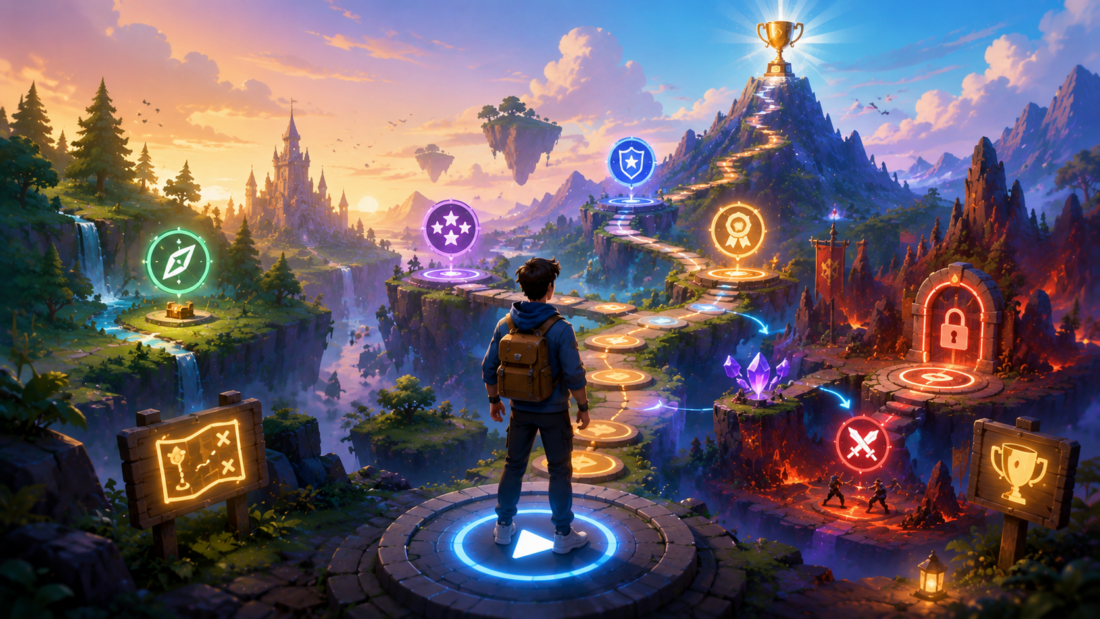
Gamification: it’s your turn!
Gamification is not just about making training more fun: its primary aim is to foster long-term engagement among learners by placing them at the heart of the experience.
By utilising mechanisms such as challenges, progression, rewards and exploration, it fosters engagement, perseverance and a desire to learn. When integrated into a coherent educational approach, gamification becomes a powerful tool for transforming learning into an active and stimulating experience.

Bloom’s Taxonomy, training and Virtual Reality? Eureka!
From memorisation to creation, every learning process draws on different levels of skill.
Bloom’s taxonomy helps to structure this progression and is now a benchmark in the world of training.
Combined with virtual reality, it opens up new possibilities for learning more effectively through immersive and engaging scenarios.
Gamification and training
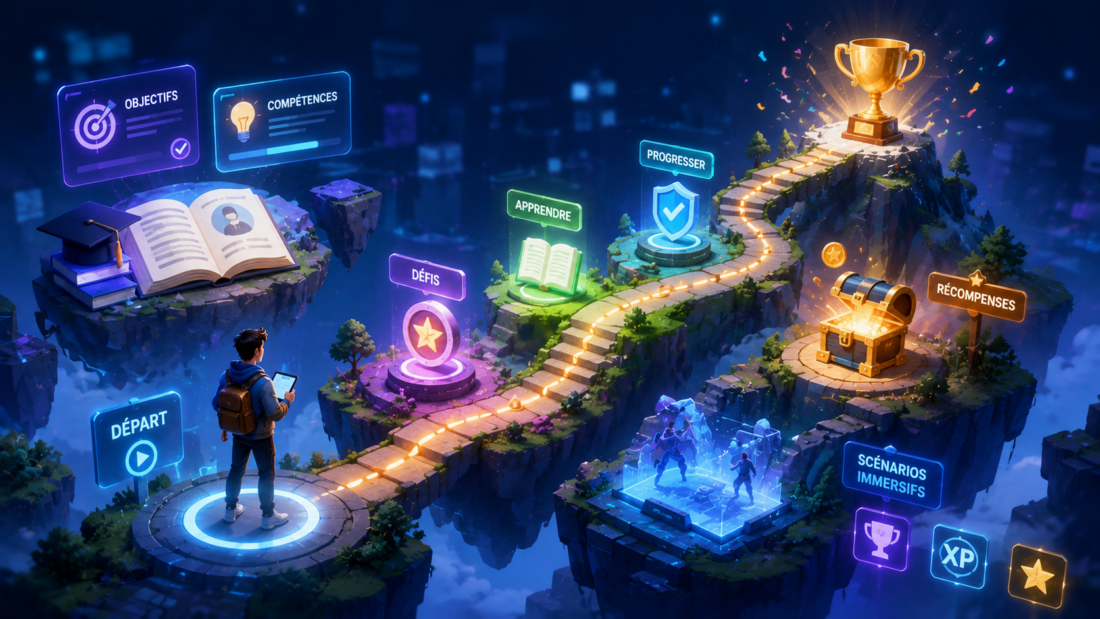
Gamification in training involves incorporating game-based mechanisms to boost learner engagement and facilitate the acquisition of new skills.
Challenges, levels, rewards, progression and immersive scenarios help transform what can sometimes be a passive learning experience into a more interactive and motivating process.
Combined with technologies such as virtual reality, gamification promotes engagement, retention and action by placing the learner at the heart of the experience.