

Why should we use microlearning?
In an age where our attention is increasingly in short supply, traditional training formats sometimes show their limitations.
Microlearning responds to this trend by offering short, targeted and easy-to-digest content.
An approach that promotes engagement, retention and learning when the need arises.
 Environ 4 min.
What is microlearning?
The concept of microlearning (or ‘Learning Nuggets’) has become a common term in the learning and development sector, but what does it actually mean? If you’re new to this term, you’ll probably say: ‘a short training session, less than 5 minutes’.
You’re not entirely wrong, but you’re not quite right either!
In short, it is a distance learning method consisting of short modules (less than 5 minutes) each focusing on a specific concept, all of which are available at any time.
The advantage of this type of learning is that learners are not overwhelmed with information they won’t retain. The idea is to provide enough content to enable them to achieve a specific, practical goal.
So, in practical terms, what are the benefits?
Opting for this learning method is a strategic choice for the company. By making all the modules the employee will need available, the company gives them the freedom to choose. Not only what they learn, but also when, where and using which resources. The learner, so to speak, holds the ‘cards’ to succeed on their own terms, without constraints imposed by management.
As the videos are short—less than 5 minutes long—they fit perfectly into even the busiest of schedules.
For example, I need to know how to prepare for my one-to-one review. On my way home, whether on public transport or on foot, I can prepare for it.
By adopting this training strategy, the company enables employees to take ownership and become fully involved in their own learning. They are no longer obliged to attend training; they choose to train whenever they wish, at the moment they need to. They feel valued and motivated by the new skills they develop as they go along.
But what can we learn?
I’d like to say: everything! Micro-learning simply means that training modules are short and focused (to put it briefly). It is therefore up to the designers to break the content down into smaller units so that it best meets the needs of the employees taking the course.
By doing this, they will be able to develop both ‘hard skills’ and ‘soft skills’. What matters is that the content is delivered regularly and is easily accessible, so that learners can make progress and learning becomes second nature.
In conclusion
Micro-learning makes digital learning much more accessible. To sum up, the formula would be:
- In a bowl, put short, targeted content
- include content that is accessible on mobile devices (allowing users to review it and access it at any time)
- add a touch of interactivity
- add a touch of gamification
- add an element of sharing to facilitate peer-to-peer learning
- And there you go, it’s ready!
WiDiD is here to advise and support you through the process of digitising your content at every stage of the process outlined above. After all, it’s not always easy to get started without having all the necessary resources or the technical expertise.
Plus d'articles
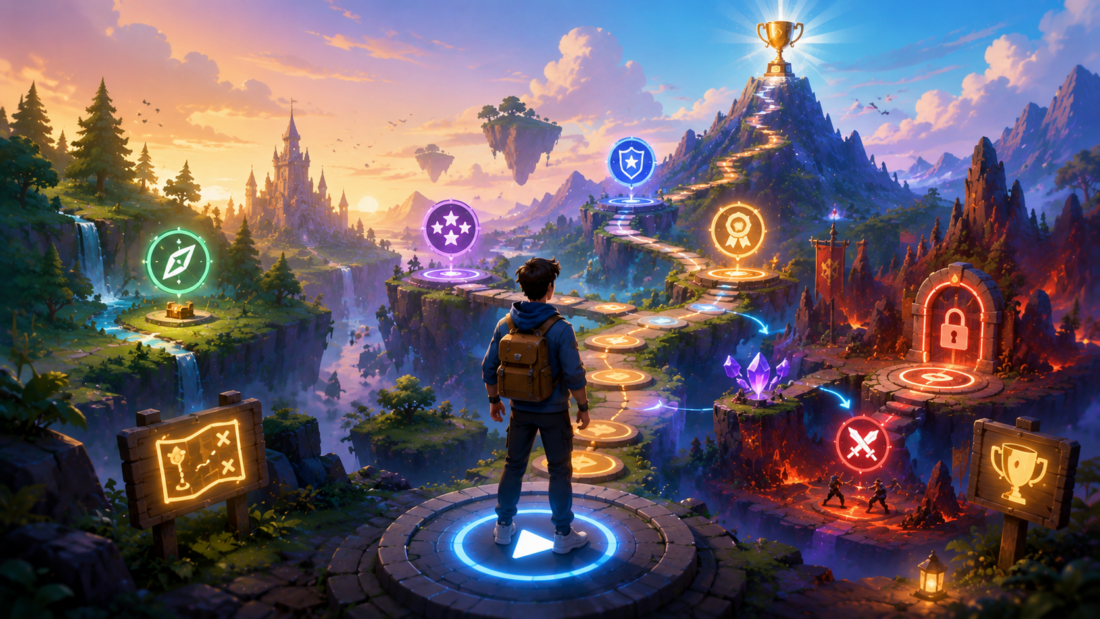
Gamification: it’s your turn!
Gamification is not just about making training more fun: its primary aim is to foster long-term engagement among learners by placing them at the heart of the experience.
By utilising mechanisms such as challenges, progression, rewards and exploration, it fosters engagement, perseverance and a desire to learn. When integrated into a coherent educational approach, gamification becomes a powerful tool for transforming learning into an active and stimulating experience.

Bloom’s Taxonomy, training and Virtual Reality? Eureka!
From memorisation to creation, every learning process draws on different levels of skill.
Bloom’s taxonomy helps to structure this progression and is now a benchmark in the world of training.
Combined with virtual reality, it opens up new possibilities for learning more effectively through immersive and engaging scenarios.
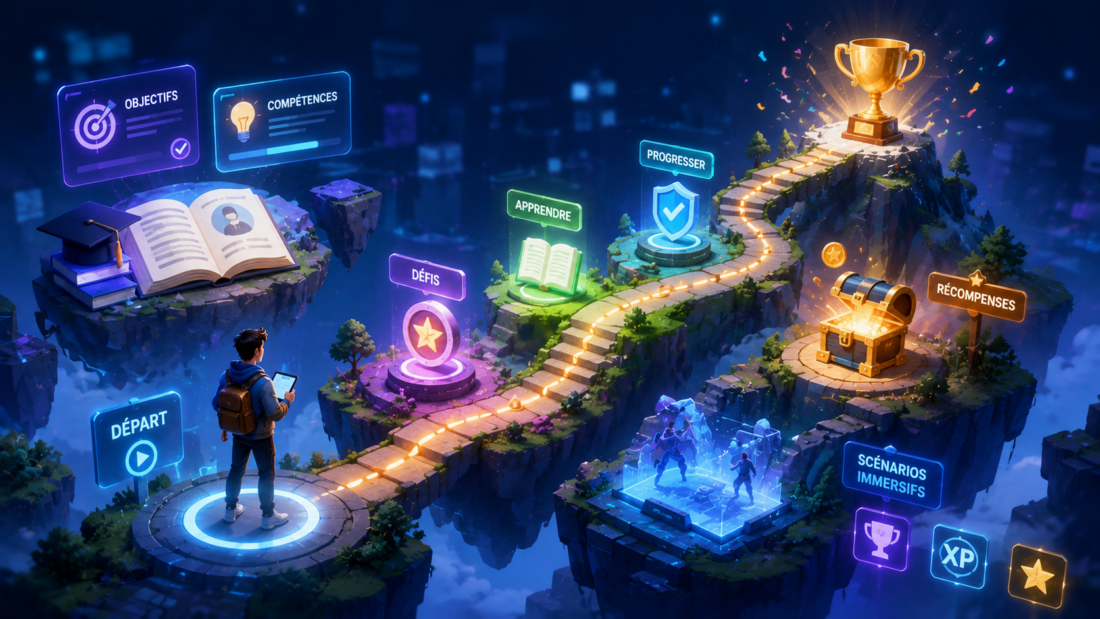
Gamification and training
Gamification in training involves incorporating game-based mechanisms to boost learner engagement and facilitate the acquisition of new skills.
Challenges, levels, rewards, progression and immersive scenarios help transform what can sometimes be a passive learning experience into a more interactive and motivating process.
Combined with technologies such as virtual reality, gamification promotes engagement, retention and action by placing the learner at the heart of the experience.