
Bloom’s Taxonomy, training and Virtual Reality? Eureka!
From memorisation to creation, every learning process draws on different levels of skill.
Bloom’s taxonomy helps to structure this progression and is now a benchmark in the world of training.
Combined with virtual reality, it opens up new possibilities for learning more effectively through immersive and engaging scenarios.
 Environ 11 min.
But what exactly is immersive learning? What does it have to do with virtual reality or training?
First of all, and to ensure you fully understand what follows, I’m going to give you our definition (at WiDiD) of this term we’re seeing more and more often: Immersive Learning. For us, it’s educational content designed to immerse the learner in an experience where they’ll learn more effectively, and sometimes without even realising it. And yes, training and virtual reality go together very well indeed.
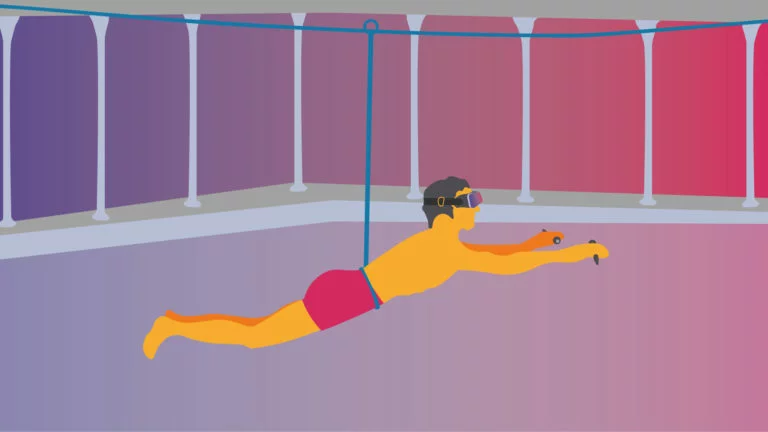
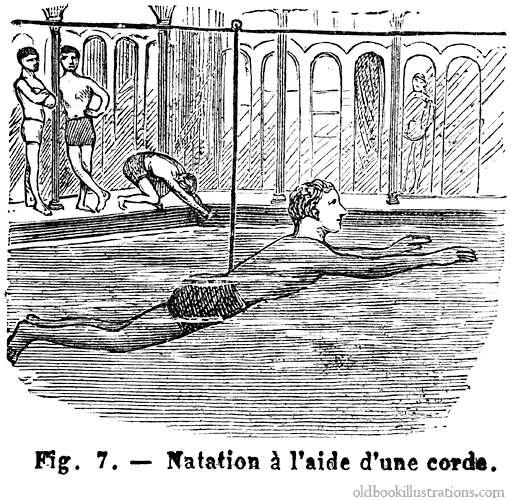
To really get the idea, think of a beginner swimmer: the best way to learn (the only way?) is to get in the water, isn’t it? Of course, we make sure they’re safe, whether with a rope or a Virtual Reality simulation – a safe environment where mistakes have no consequences.
It is clear that the best way to immerse yourself safely is through Virtual Reality (VR).
When well-designed, a VR experience has so much more to offer than just passive media content. It allows learners to experience, practise and, of course, develop their skills. We can immerse ourselves in a past or future era. We can also carry out scientific experiments that would otherwise be impossible. Put ourselves in someone else’s shoes, to feel what they feel? Yes, it’s possible!
The immersive nature of VR engages learners’ minds and bodies far more effectively than other learning media, such as e-learning.
Taxo what? Bloom’s taxonomy
So, for those in the know, skip straight to the next section. For everyone else, stick around – we’ll take it step by step! For the full details, head over to Wikipedia.
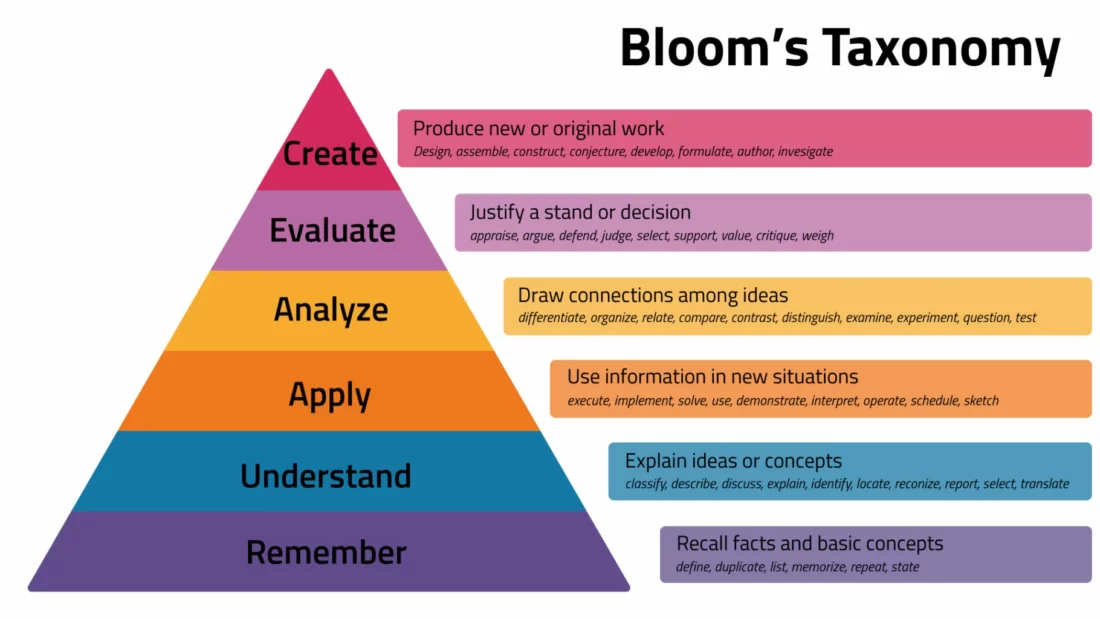
In a nutshell, this is how it works. Benjamin Bloom and his colleagues developed this tool in the 1950s to help teachers assess their pupils’ level of understanding. It consists of six hierarchical levels, with typical tasks associated with each level.
In short, to master a subject or a piece of knowledge …, you must first memorise it, understand it, know how to apply it, and know how to link it to other things. Finally, the last two levels are not always applicable. These are the ones that mark the ability to step back from the subject, either to reuse it and combine it with others, or even to innovate and turn it into something else.
So what difference does virtual reality make?
And yes, can we still use this taxonomy to fully understand the relationship between training and virtual reality?
Remember – Memorise
How does memory work? Apparently, there are several areas of the brain involved in the process of memorisation. Sometimes we talk about ‘body memory’ – for example, a smell that reminds us of our childhood. In virtual reality, we can’t smell anything yet, except in a few very complex experiences. On the other hand, we move around, we grab things, we speak – in short, we stimulate our senses more than we do when sitting passively in front of a video. ClassVR, for example, allows a teacher to deliver a history lesson at a historical site. Pupils remember things better, of course.
But is there still a need to memorise things in the age of search engines and voice assistants? In other words, if your educational aim is for the learner to memorise information, don’t bother with VR. Use a more traditional method; it’ll do the job just fine, and then, from time to time, ask yourself whether this objective is really necessary (^^).
Understand – Understand
Try Google Earth VR, and you’ll understand just how round the Earth is; you’ll get a real sense of the scale of Angkor Wat or the grandeur of Kilimanjaro. Ah yes, now I really understand why it’s tiring to walk around New York – it’s so vast! Or why life is simpler in temperate countries; in the desert, well, it’s just the desert – nada, nothing, zilch!
Apply – Use
The best way to really make progress in a foreign language is to chat with native speakers. That’s why language immersion courses abroad are so popular and effective. Yes, but how many of us can afford them? In Mondly VR, I have to manage to buy a plane ticket and check into a hotel (very ordinary, practical tasks that we’re all dreaming of right now 🙂 ). Instead of memorising and repeating phrases out of context, I’m in an environment that forces me to pick up language skills because I need them to get on with things. I’m driven by the goal of achieving something (hey there, gamification 🙂 )
Analysis – To analyse
Taking a step back from the subject so that you can analyse it, compare it with others… Do you remember those biology lessons where we had to dissect a cockroach? The idea wasn’t ‘how to learn to torture insects’ ’ No, no (although…). Our teacher (Mrs Durand in my case) was trying to help us visualise the relationship between the anatomical parts that make up a cockroach. Rather than drawing a 2D diagram, we were ‘immersed’ (brrrr, it gives me the shivers of disgust) in the cockroach. The intended outcome: to analyse how the cockroach’s body functions (or rather, used to function) and extrapolate this to all other animals.
It’s not an easy transition, but Sharecare VR is a real-time simulation of the human body, allowing users to navigate freely through the body and its organs and analyse how they work.
Evaluate – Forming your own opinion
VR experiences such as ‘Sexual Misconduct Prevention Training’ or the fabulous ‘Clouds Over Sidra’ allow us to go even further. Here, we feel what the characters are feeling; we are in their shoes or right beside them. In addition to our analytical faculties, our emotions are engaged; we are no longer merely observing, we “are”.
Sidra, a 12-year-old Syrian girl, shows me around her refugee camp through her daily life and activities. It’s an experience quite unlike reading an article or watching a video.
In the Regatta VR simulation, I step into the shoes of the characters. I am Laura, the one being harassed; I am the colleague who witnesses the scene; and finally, I am the manager to whom Laura confides. What other tool but virtual reality allows us to empathise in this way?
Create
This is the realm of the new and of innovation. What’s interesting about VR is the ability to visualise and even immerse oneself in abstract concepts (think of Tom Cruise in *Minority Report*). Well, that’s what Noda promises.
Noda lets you lay out your ideas, connect concepts, see their structure and delve into the details. Bring your thoughts together with immersive technology. Move around, walk amongst them and get to work. Or sit back and watch your ideas and connections unfold around you. It speaks for itself, doesn’t it? VR gives us the tools to travel through our minds, but also to connect them with others!
Bloom’s taxonomy: understanding the educational impact of each virtual reality training experience
We have just looked at, step by step, what virtual reality can offer (and how) in the field of training.
Here is Steven Bambury’s revised version of Bloom’s taxonomy.
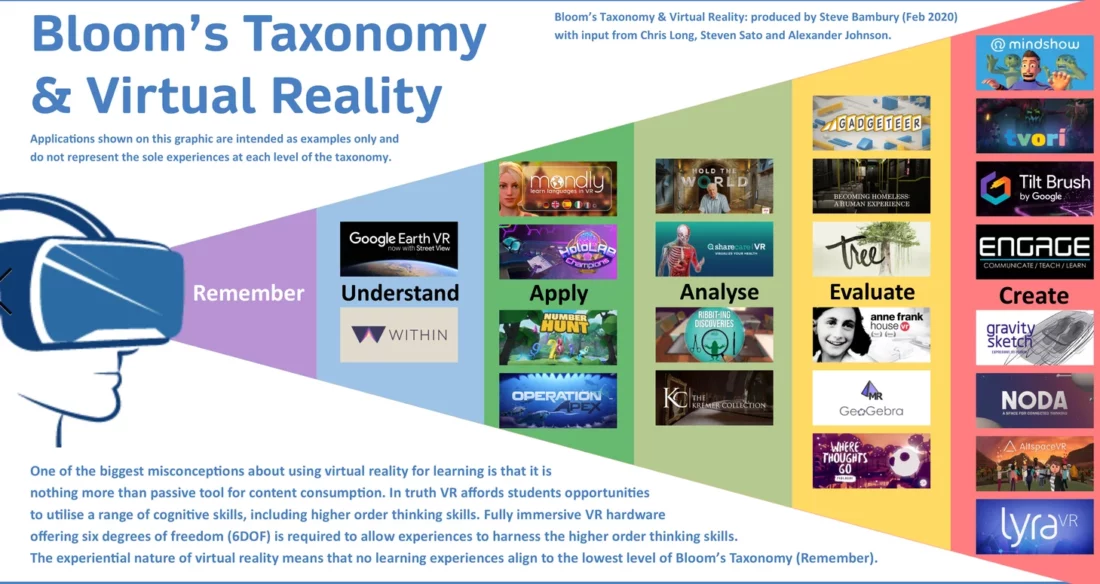
Virtual reality and immersive learning are tools, and we choose a tool based on how we intend to use it and how well we can master it. Give me a Formula 1 car to learn to drive in, and you’ll see what I mean.
I hope you’ve learnt something from reading this; next time, I’ll do it in VR, I promise! Share, like, comment, and get in touch!
At WiDiD, we value open dialogue and hold strong convictions. We are committed to ensuring that everyone can make the most of digital technology, learning at their own pace and in line with their goals, with the best tools and the best coaches. And we are experts in the field of virtual reality and training.
Plus d'articles
Gamification and training
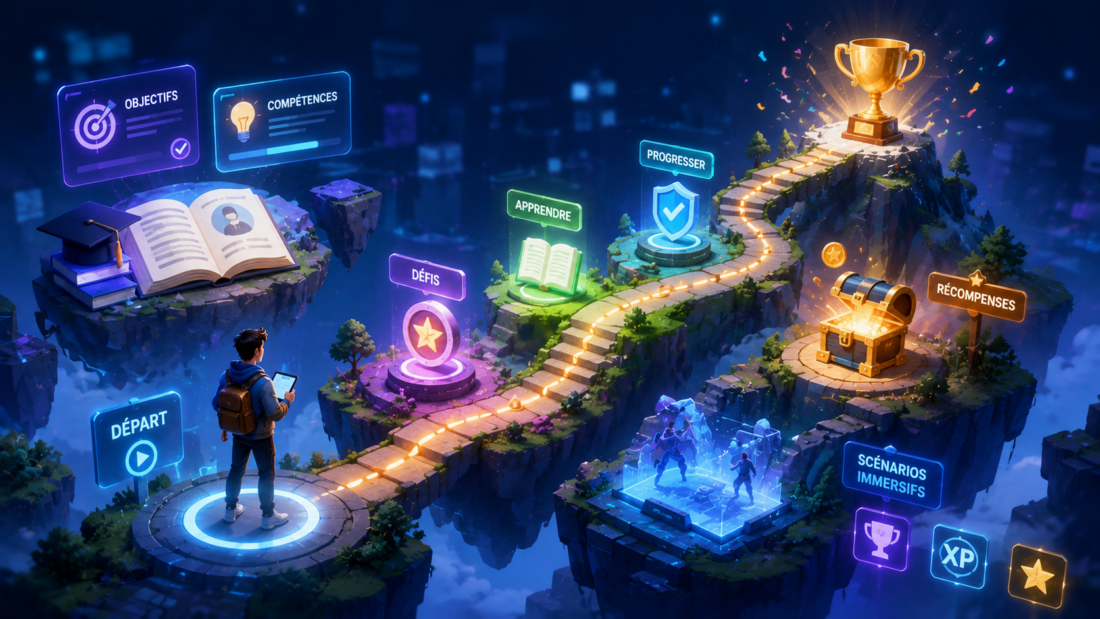
Gamification in training involves incorporating game-based mechanisms to boost learner engagement and facilitate the acquisition of new skills.
Challenges, levels, rewards, progression and immersive scenarios help transform what can sometimes be a passive learning experience into a more interactive and motivating process.
Combined with technologies such as virtual reality, gamification promotes engagement, retention and action by placing the learner at the heart of the experience.
Gamification: Bartle’s typology
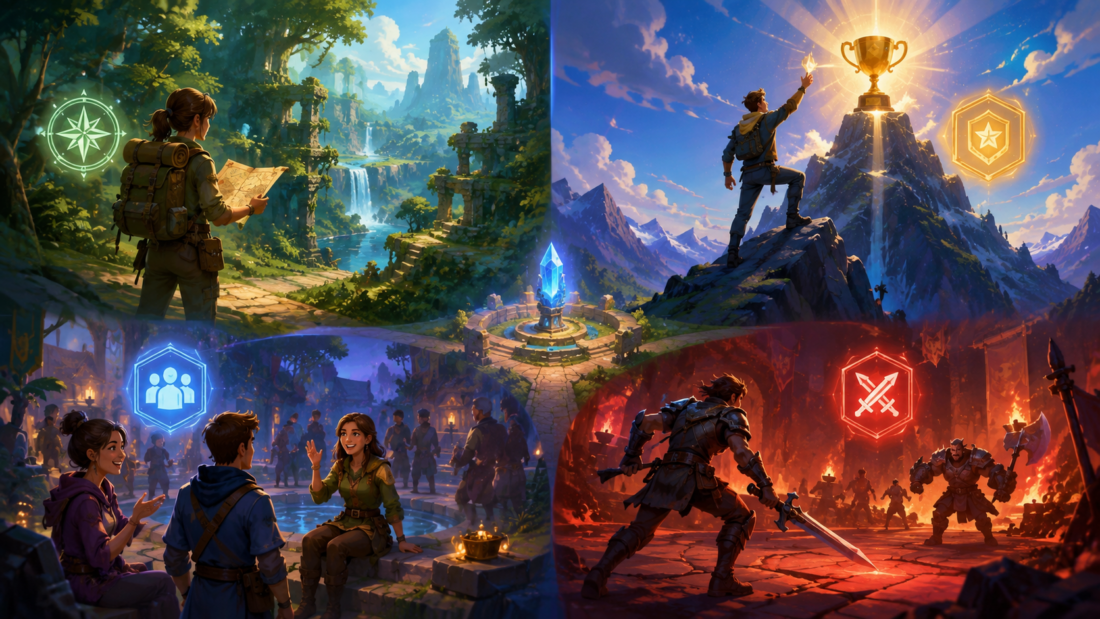
Bartle’s typology is a standard model used to understand different player profiles and their sources of motivation.
Developed by Richard Bartle, it identifies four main categories: Explorers, Achievers, Socialisers and Competitors .
Even today, this classification is widely used in the design of gamified experiences and immersive training programmes, as it enables game mechanics to be adapted to learners’ expectations and behaviours in order to boost their engagement.
What is gamification?
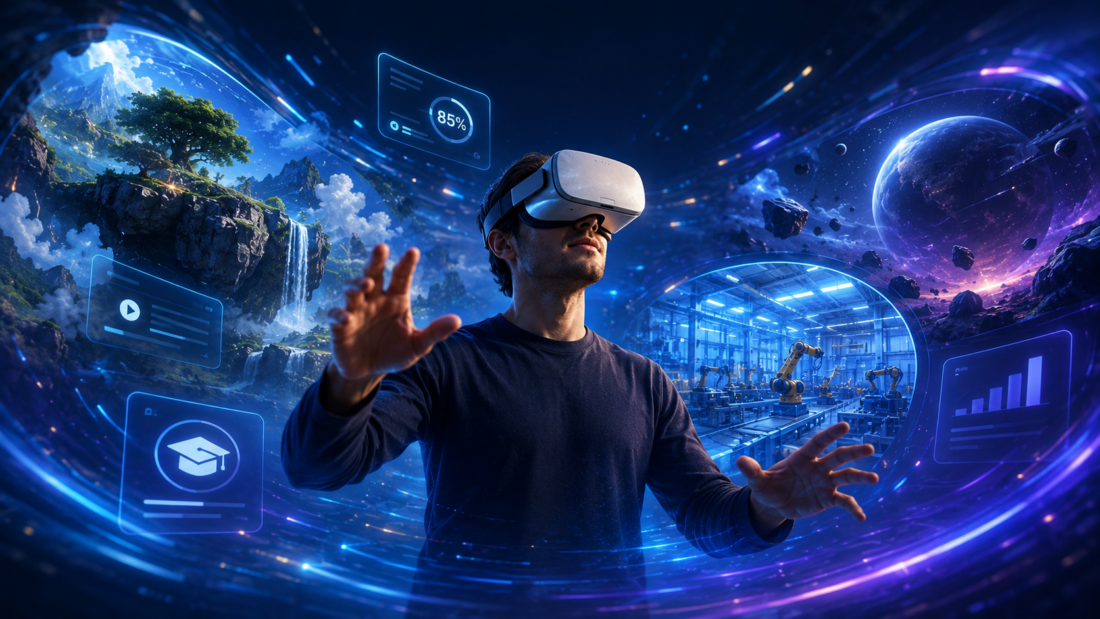
Gamification involves incorporating game mechanics into contexts that are not inherently playful.
Its aim is simple: to boost engagement, stimulate motivation and promote learning through elements such as challenges, rewards, levels and progression systems. When combined with immersive technologies such as virtual reality, it transforms the training experience into an interactive adventure where the learner takes full control of their own journey.